Living Under the Layoff Shadow


MIND–BODY PATTERN OF THE WEEK
Few experiences are more psychologically exhausting than living with the persistent possibility of losing something that has not yet been taken away.
Across the technology sector, thousands of senior leaders wake each morning carrying a question they cannot answer. Will I still have a job next month? Will my organisation restructure again? Will the next calendar invitation be the conversation that changes everything?
For many, this uncertainty has lasted far longer than the layoff announcements themselves.
This is the mind–body pattern of the week: living in anticipated loss.
From a psychosomatic perspective, the nervous system does not respond only to events that have happened. It also responds to events that feel increasingly likely. When uncertainty persists without resolution, the body begins preparing for a future loss that has not yet occurred. Fear gradually becomes a physiological state rather than an emotional reaction.
This is why prolonged organisational uncertainty affects leaders so profoundly. They continue to attend meetings, make decisions and lead teams, yet much of their internal capacity is quietly redirected toward one question: Am I next?
The search for certainty begins to dominate attention. Leaders analyse every organisational announcement, every cancelled project, every change in reporting lines, every unexpected meeting invitation. They replay conversations with their managers, comparing today’s language with yesterday’s. Performance reviews that once provided confidence now offer only temporary reassurance. The mind becomes occupied by prediction because prediction feels safer than surprise.
Over time, this relentless vigilance reshapes the body as well as the mind.
Sleep becomes fragmented because the nervous system remains alert long after the working day has ended. Minor illnesses become more frequent as recovery is repeatedly interrupted. Headaches, digestive problems, muscular pain, heart palpitations and persistent fatigue begin appearing in people who previously considered themselves healthy. Leaders often describe feeling mentally exhausted before the day has even begun, as though the body has spent the night preparing for a battle that never arrived.
Fear is one of the most powerful disruptors of human physiology because it rarely remains confined to thought. When sustained over months, it alters attention, narrows perspective and changes how people relate to one another. Leaders become more cautious, less creative and increasingly reluctant to take risks. Teams mirror the same pattern. Conversations become more guarded. Innovation slows.
The greatest tragedy is that many leaders cannot simply walk away. Financial commitments, family responsibilities and retirement plans make leaving impossible. They continue performing because they must, even as their physical and psychological resources steadily diminish. Many begin taking more sick leave, not because they have become less resilient, but because the organism can no longer sustain a prolonged state of vigilance without consequence.
Organisations often measure the impact of layoffs from the day employees leave the building. The nervous system begins measuring it much earlier.
Long before a redundancy is announced, fear has already begun reshaping health, leadership and culture. The body starts carrying the possibility of loss before the loss itself has become reality.
This is the cost of living under the layoff shadow. It is not only the fear of losing a job. It is the gradual erosion of the mind and body health while trying to hold on to one.
L&D-LED WORKPLACE WELLBEING
When organisations enter periods of uncertainty, leaders often feel responsible for protecting everyone else while quietly carrying their own fears. This is precisely when workplace wellbeing must move beyond resilience workshops and become a leadership capability.
The first step is recognising that fear is not a personal weakness. It is a normal response to prolonged uncertainty. Trying to suppress it or simply “stay positive” rarely works.
Naming the fear, acknowledging the uncertainty, and talking about it with trusted colleagues, coaches, mentors, or family members reduces the burden of carrying it alone.
Equally important is resisting the urge to let uncertainty consume every aspect of life. Fear has a remarkable ability to convince us that constant vigilance will keep us safe. In reality, the nervous system recovers when it experiences moments that remind it life is larger than work. Time with family, meaningful conversations, exercise, travel, hobbies, and uninterrupted sleep are not distractions from performance. They are what preserve the capacity to perform.
Leaders also have an opportunity to shape how uncertainty is experienced by those around them. They may not be able to change organisational decisions, but they can create stability through honest communication, empathy, and psychological safety.
People cope better with difficult truths than prolonged ambiguity. A leader who listens, remains present, and acknowledges uncertainty without amplifying fear becomes a source of regulation for the entire team.
In Psychosomatic Leadership™ , the objective is not to eliminate uncertainty. It is to prevent uncertainty from becoming the organising principle of the nervous system and physical wellbeing. When leaders learn to regulate their own internal state, they protect more than their health. They preserve their judgment, strengthen their teams, and help create workplaces where fear no longer dictates how people think, feel, and perform.
NERVOUS SYSTEM LITERACY IN ACTION
Leader: “I haven’t been sleeping properly for weeks. Every time I wake up, the first thing I think is, ‘What if today’s the day?'”
Lina (coach): “The day for what?”
Leader: “The call. The email. The restructure. Everyone’s talking about it. Another round is coming.”
Lina: “Has anyone told you your role is at risk?”
Leader: “No.”
Lina: “So what are you responding to today? A confirmed event or a possible future?”
Leader: (pauses) “A possible future.”
Lina: “How certain does that future feel in your body?”
Leader: “One hundred percent.”
Lina: “How certain is it in reality?”
Leader: “…I don’t know.”
Lina: “What do you notice as you say those words?”
Leader: “My chest is tight. My stomach feels like it’s in knots.”
Lina: “How long has your body been carrying that feeling?”
Leader: “Months. Every time there is another announcement, it gets worse.”
Lina: “What has that uncertainty changed for you?”
Leader: “I’m second-guessing everything. I keep working longer hours because I feel like I have to prove my value. I’m constantly checking Teams and Outlook. Even when I’m home, I’m not really with my family.”
Lina: “What is the cost of living that way?”
Leader: (long silence)
Leader: “I don’t recognise myself anymore. My daughter asked me last week why I’m always distracted. That hit me.”
Lina: “What do you wish she experienced instead?”
Leader: “That I was actually there.”
Lina: “If the outcome you’re fearing happened tomorrow, what would you still have?”
Leader: (thinks)
Leader: “My family.”
Lina: “What else?”
Leader: “My health… if I don’t destroy it first.”
Lina: “Your experience. My relationships. My ability to build something new.”
Leader: “As you say that, what changes inside you?”
Leader: “I can breathe a little easier.”
Lina: “What do you think your nervous system has been protecting?”
Leader: “My job.”
Lina: “What if it has been protecting something much bigger?”
Leader: “My identity.”
Lina: “If your identity is larger than your job, what becomes possible?”
(The room falls silent.)
Leader: “I stop living as though I’ve already lost everything.”
TAKEAWAY FOR LEADERS AND L&D PROFESSIONALS
This conversation was not about convincing the leader that everything would be okay. Neither the coach nor the leader knew what organisational decisions lay ahead.
The shift came from separating uncertainty from certainty. As the leader became aware of how much of his energy was being spent living in an imagined future, he was able to reconnect with what remained true in the present. That awareness did not remove the possibility of redundancy, but it reduced the grip that fear had on his nervous system.
This is where coaching becomes invaluable during periods of organisational uncertainty. It helps leaders distinguish between what is happening today and what the mind is predicting about tomorrow. That distinction creates space for choice, restores perspective, and allows leaders to show up more fully for themselves, their families, and their teams even when the future remains unknown
WHAT LEADERS SAY
Some Microsoft employees were lucky enough to learn about Coaching from Lina as part of the Microsoft ANZ Mentor program. Although I’ve been a mentor before, I never really understood the difference between coaching and mentoring. This course helped me understand the difference and how to perform better in both the role of mentor and coach (the latter being a real bonus!). Eight hours, over two sessions, of theory and practice, brought home some significant learnings. – Sandy A., Program Delivery at Microsoft
NOW WHAT?
You’ve noticed how your mind and body show up under pressure now what do you do with that insight?
Awareness is only the beginning. Mind-body pattern recognition happens in real conversations, real decisions, and real leadership moments
If this edition resonated, it may be because you recognise that many leadership challenges are not simply strategic, behavioural, or psychological. They are psychosomatic. The mind and body are carrying the same story.
My work sits at the intersection of leadership, nervous system regulation, and human performance.
Business: Psychosomatic Leadership®
I partner with organisations, executive teams, and senior leaders to build leadership capacity through the Psychosomatic Leadership® framework. This work focuses on leadership effectiveness, workplace wellbeing, burnout prevention, psychological safety, coaching, culture transformation, and the development of Psychosomatic Intelligence (PIQ®) as a measurable leadership capability.
Clinical healthcare: Restoring Mental and Neurological Health
For individuals, I provide integrative support focused on restoring mental and neurological health. My clinical work includes depression, anxiety, burnout, sleep and eating disorders, addiction, PTSD, ADHD/ASD, suicide prevention, migraines, headaches, epilepsy, and other conditions where psychological and physiological patterns are deeply interconnected.
Whether the goal is stronger leadership capacity, recovery from burnout, or navigating a major life transition, the work begins in the same place: understanding what the mind knows, what the body is carrying, and how to help both move forward together.
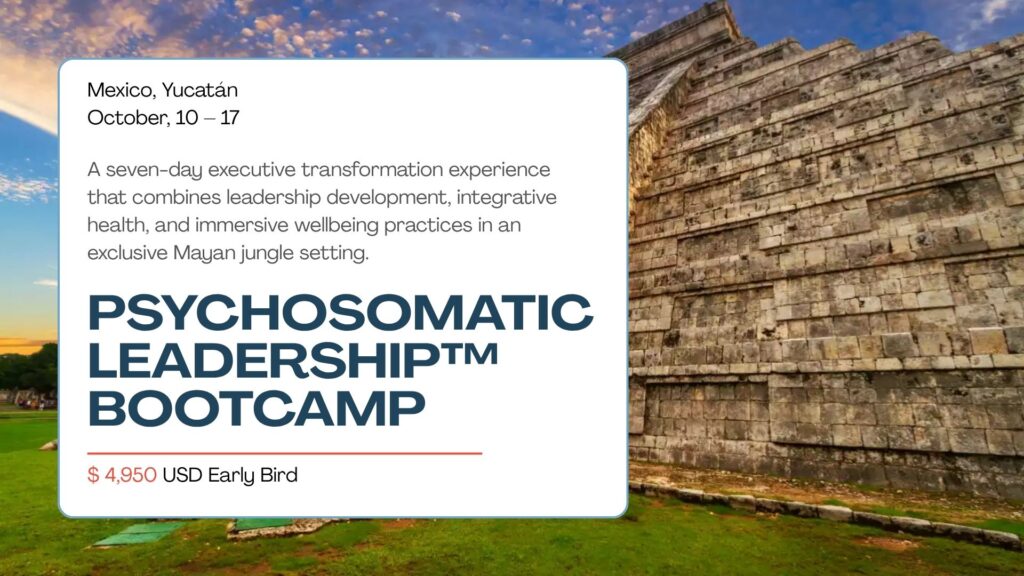
The next Psychosomatic Leadership™ Bootcamp is in Mexico, Yucatán, October, 10 – 17 (7 days).
$ 4,950 USD Early Bird

Set in an exclusive private retreat hidden among the ancient Mayan jungle, this immersive experience offers a rare opportunity to disconnect from the noise of everyday life and reconnect with yourself. Surrounded by nature, sacred cenotes, and authentic local culture, every element of the setting has been chosen to support deep personal transformation.

GET MORE INFO or RESERVE YOUR SPOT [email protected]