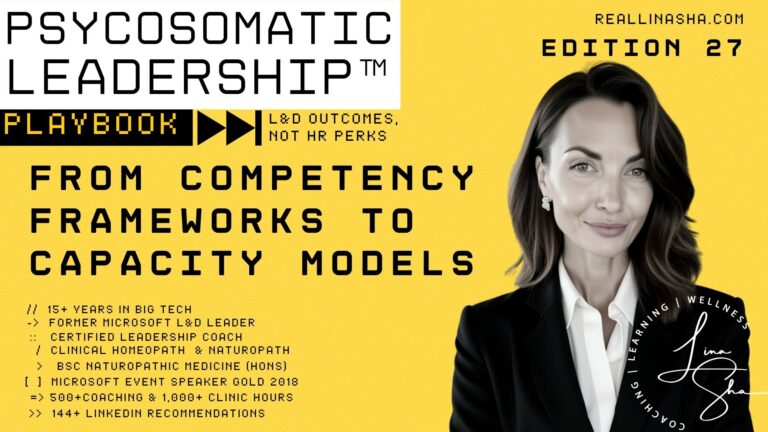
From Competency Frameworks to Capacity Models

MIND–BODY PATTERN OF THE WEEK
Most leadership failures in technology organisations are not caused by a lack of competence. They happen when leaders operate beyond their physiological capacity.
In Big Tech, sales and engineering leaders are highly capable. They understand strategy, execution, emotional intelligence, and stakeholder management. On paper, they meet every requirement of modern competency frameworks. Yet under sustained pressure, aggressive targets, product delays, constant escalation behaviour narrows. Pace accelerates. Control tightens. Listening drops. Teams burn down.
This is not a skills gap. It is a capacity gap.
Competency frameworks describe what leaders should be able to do. Capacity determines what leaders can actually sustain under real conditions. Two leaders can have identical competencies and radically different outcomes. One stabilises teams during high-pressure quarters. The other unintentionally transmits urgency, exhaustion, and reactivity.
From a psychosomatic leadership perspective, behaviour under pressure is an output of physiological state. When demand exceeds regulatory capacity, the nervous system defaults to survival strategies: urgency, over-efforting, emotional suppression, and control. Insight remains available cognitively, but inaccessible when it matters most.
This pattern shows up clearly in sales and engineering environments. Leaders stay mentally sharp while their bodies remain permanently mobilised. Sleep deteriorates. Recovery never fully lands. Irritability increases. Decision quality narrows. Teams feel the pace before anyone names the problem.
Competency frameworks cannot see this. They assess capability, not capacity.
Psychosomatic Leadership™ places capacity at the centre of leadership development. It recognises that sustainable performance depends on a leader’s ability to regulate internal load, complete stress cycles, and remain present under pressure. Without this, competencies collapse into effort-heavy performance and burnout cycles.
Capacity can be measured.
Psychosomatic Intelligence (PI), quantified through the PIQ™ (Psychosomatic Intelligence Quotient), assesses a leader’s physiological readiness to hold complexity without leaking the cost into health, behaviour, or culture. PIQ does not evaluate skill or personality. It measures how much pressure a system can hold before it fragments.
This distinction matters because organisations are already paying for capacity failures: team burnout, attrition, unplanned leadership absences, and loss of momentum at critical moments. These costs are rarely attributed to leadership development, yet they originate there.
Competency frameworks are necessary, but no longer sufficient. The shift to capacity models acknowledges a simple reality: leadership intelligence is only as effective as the nervous system carrying it.
L&D-LED WORKPLACE WELLBEING
When organisations talk about capacity, they often mean headcount, budget, or delivery bandwidth. In leadership development, capacity means something far more precise: the nervous system’s ability to hold demand without destabilising performance, behaviour, or health.
A capacity model recognises that leadership does not break down at the level of skill. It breaks down at the level of regulation.
When leaders operate beyond capacity, the body begins to signal long before performance metrics move. These signals are frequently misunderstood, normalised, or treated in isolation. In reality, they are expressions of the same underlying mind–body pattern: sustained load without completion.
Leaders struggle to sleep despite exhaustion. The mind remains active long after work ends. They wake early with a sense of urgency or dread, even when nothing immediate is wrong. Decision-making becomes harder. Simple choices feel effortful. Strategic thinking narrows. Leaders report feeling foggy, disoriented, or mentally scattered in moments that previously felt manageable.
Emotional regulation also shifts. Irritability increases. Small obstacles provoke disproportionate anger. Some leaders experience emotional numbing, a sense of detachment from work, people, or outcomes they once cared about deeply. Others experience the opposite: sudden emotional release, including tears with no clear trigger, often during moments of pause or relief.
The body carries the load in parallel. Appetite fluctuates unpredictably, extreme hunger one day, no appetite the next. Hands tremble subtly during high-pressure conversations. Heart palpitations appear without exertion. Muscle tension becomes constant. Fatigue deepens, yet rest fails to restore.
These are not personal weaknesses. They are capacity signals.
When leaders override these signals and continue operating as if nothing is wrong, the cost shifts outward. Teams inherit the dysregulation. Pace accelerates. Psychological safety erodes. Mistakes increase. Burnout spreads. Eventually, leaders themselves are forced out of the system temporarily through illness, stress leave, or burnout recovery, removing critical capability from the business at moments of peak demand.
This is why L&D-led workplace wellbeing must move beyond support and into capacity architecture.
A capacity model includes the development of nervous system literacy as a core leadership skill. Leaders learn to recognise mind–body patterns early, not as health issues, but as performance-relevant data. They understand how internal state shapes behaviour, decision quality, and team dynamics. They develop the ability to regulate in real time, rather than recover after collapse.
Psychosomatic Leadership™ operationalises this shift. It does not pathologise leaders or slow organisations down. It builds internal stability so leaders can sustain complexity without transmitting cost.
When leaders develop psychosomatic intelligence, the impact is immediate and observable. Decision-making stabilises. Emotional range returns. Sleep improves. Teams feel safer, not because leaders are softer, but because their nervous systems are no longer leaking unresolved pressure into the environment.
This is the distinction between competency-led and capacity-led leadership development.
Competency models ask whether leaders know what to do. Capacity models ensure leaders can do it sustainably.
In 2026, organisations that fail to build leadership capacity will continue paying for it in hidden ways. Those that shift will not just protect wellbeing, they will protect performance, culture, and continuity at the level that matters most. That is the role L&D must now step into.
NERVOUS SYSTEM LITERACY IN ACTION
Leader: “I don’t think I’m burnt out. I’m still delivering. I just feel… off.”
Lina (coach): “When you say ‘off’, what do you notice in your body right now?”
Leader: “My chest feels tight. And my hands are slightly shaky. I’ve been noticing that in meetings.”
Lina: “How long has that been happening?”
Leader: “Months. I assumed it was just pressure. It comes and goes. Sometimes my heart races for no reason.”
Lina: “What happens to your thinking when that shows up?”
Leader: “I get impatient. Decisions feel harder. I second-guess things I normally wouldn’t. And I’m more reactive with my team than I want to be.”
Lina: “What do you do when you notice those signals?”
Leader: “I push through. I tell myself to focus. There’s no time to stop.”
Lina: “What happens later?”
Leader: “I crash. I can’t sleep. Or I wake up at 3am wired. Sometimes I feel numb. Other times I get emotional over things that don’t usually affect me.”
Lina: “If those signals weren’t problems to eliminate, what might they be telling you?”
Leader: (long pause) “That I’m operating beyond capacity. That I’m holding too much.”
Lina: “And how do you think that shows up for your team?”
Leader: “They’re tense around me. They rush. They don’t bring issues early. I can see them burning down.”
Lina: “So your system sets the pace, whether you intend it to or not.”
Leader: “Yes. I thought leadership was about endurance. I didn’t realise I was modelling overload.”
Lina: “What would change if regulation was treated as leadership capability, not a personal issue?”
Leader: “I’d slow decisions without guilt. I’d stop transmitting urgency. I’d lead from steadiness instead of pressure.”
Lina: “And what do you notice in your body as you say that?”
Leader: “My breathing just dropped. My hands aren’t shaking. I feel clearer.”
Lina: “That shift is capacity coming back online…”
Coaching takeaway for Leaders and L&D Professionals
This change did not come from new skills, feedback, or mindset shifts. It came from recognising a mind–body pattern that had been driving leadership behaviour beneath awareness.
The leader did not need motivation or resilience training. He needed capacity, the ability to recognise when his nervous system was overloaded and to regulate before that load spilled into decision-making, team dynamics, or health.
This is what capacity models make visible. Coaching becomes the mechanism through which internal load is surfaced early, patterns are integrated, and leadership capability becomes durable rather than effort-dependent.
WHAT LEADERS SAY
Lina consistently demonstrated a passion for helping others grow. She often took the initiative to coach colleagues, sharing insights and best practices, and even sent out regular newsletters to foster a culture of learning and development within the team. It is therefore no surprise that she is now pursuing a career as a professional coach, a path for which she is exceptionally well-suited. Lina is a highly capable, intelligent, and driven individual who is eager to learn and excel. – Siham K., COO Microsoft MEA Growth Markets
NOW WHAT?
You’ve noticed how your mind and body show up under pressure now what do you do with that insight?
Awareness is only the beginning. Mind-body pattern recognition happens in real conversations, real decisions, and real leadership moments.
First half of 2026 I have quite an amazing line up of business travel and I would love to meet not only my exhisting business partners and friends but also expand my network, over coffee conversations with like-minded leaders. I’m also available for leadership intensives and keynote speaking opportunities at team offsites, learning days, and sales kick-offs, where wellbeing, performance, and human sustainability need to coexist.
Not in those locations? Check out upcoming retreats in Mexico and Argentina end of 2026 at (The Psychosomatic Leadership™ Immersion in Costa Rica 21–28 Feb is SOLD OUT)
learn_with_Lina -> exec coaching, corp training, public speaking
health_with_Lina -> clinical support of mind and neuro conditions such as depression, anxiety, chronic stress, burnout, sleep disorders
time_with_Lina -> retreats
[email protected]