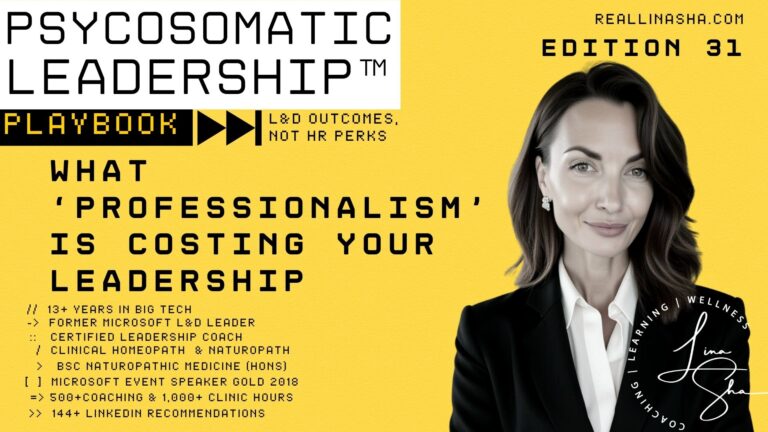
What ‘Professionalism’ Is Costing Your Leadership

MIND–BODY PATTERN OF THE WEEK
Professionalism is rarely presented as emotional labour. In executive culture, it is framed as maturity, judgment and control.
Senior leaders are expected to absorb pressure without visibly reacting, remain calm through conflict, and protect the room from whatever they are carrying internally. In many organisations, this is not only admired,it is promoted.
It points to the cost of “surface acting” — presenting an emotion that does not match the internal experience and links it with emotional exhaustion, burnout and poorer wellbeing outcomes. Emotional labour research also distinguishes this from deeper, more integrated emotional regulation, where the person is not simply performing calm but internally processing what is happening.
This is the mind–body pattern of the week:
Performed composure without internal completion.
In senior leadership, this pattern can look very polished. A leader walks into an escalation call after a difficult board conversation and appears steady. They give the right message, use the right tone, and reassure the team. Nothing looks wrong. Yet internally, the body has not registered resolution. The conversation has been contained, not completed.
From a Psychosomatic Leadership™ perspective, professionalism becomes costly when it teaches leaders to manage the appearance of regulation while leaving the nervous system activated underneath. The issue is not that leaders should “express everything” or bring raw emotion into every room. The issue is that many leaders are trained to edit emotion faster than they process it.
Over time, this creates a form of leadership dissonance. The outer presentation says, “I am fine.” The body says, “I am still carrying this.” This dissonance is not abstract, suppressing negative emotion can affect cardiovascular stress responses, including delayed physiological effects after the stressor has passed.
This is why the cost often appears after the meeting, not during it. The leader holds the line beautifully in the room, then feels wired at night, develops headaches after a tense week, loses appetite or overeats after intense days, or notices sudden irritability at home where the professional mask finally drops. The body does not care that the emotion was handled “appropriately” in public. It cares whether the activation was metabolised.
In workplaces, this pattern is reinforced through display rules, the formal and informal expectations about which emotions are acceptable to show. These rules exist for good reasons: they help maintain trust, service quality, and social order, while emotional labour generated by display rules can contribute to alienation, burnout, stress and lower performance when people repeatedly suppress what they actually experience.
For executive leaders, this becomes even more complex because their emotional display sets the culture. If professionalism means never showing uncertainty, teams learn to hide risk. If calm means emotional flatness, people stop bringing the full truth into the room. If composure means pressure has nowhere to go, urgency becomes the operating system.
This is where “professionalism” starts costing leadership. It does not cost leadership because composure is bad. It costs leadership when composure becomes a performance that disconnects the leader from their own internal state. The leader may still look credible, but their capacity narrows. Listening becomes selective. Patience becomes effortful. Decisions become more controlled than considered. The team may not see emotional volatility, but they feel the absence of genuine regulation.
Psychosomatic Leadership™ reframes professionalism as something more mature than suppression. It is the ability to stay present without abandoning the body, to hold emotion without performing numbness, and to process pressure without leaking it into health, tone or culture.
The next evolution of professionalism is not less composure but composure with completion.
L&D-LED WORKPLACE WELLBEING
If professionalism built on suppression is the problem, the alternative is not less professionalism but a different standard of it.
In a Psychosomatic Leadership™ model, professionalism is no longer defined by how well leaders contain emotion, but by how effectively they process and regulate it without passing the cost downstream.
The shift is subtle, but structural. Leaders are not expected to “show more emotion,” but to develop the capacity to complete what they experience so that it does not accumulate in the system. This is where L&D begins to move beyond traditional development.
Most leadership programs focus on behaviour: how to communicate, how to give feedback, how to manage conflict. These remain essential. What is added in a psychosomatic model is the internal capability that allows those behaviours to hold under pressure. Leaders learn to recognise when they are containing rather than processing, to notice physiological signals early, and to regulate before tension becomes tone, or pressure becomes pace.
Over time, this changes how organisations function. Conversations become more grounded because leaders are not carrying unprocessed load into the room. Decision-making becomes more stable because it is not driven by underlying urgency. Teams experience consistency not because leaders are controlling themselves more, but because their internal state is no longer fluctuating beneath the surface.
This is where wellbeing, culture, and performance begin to converge.
Wellbeing is no longer something leaders recover after work. Culture is no longer dependent on personality. Performance is no longer sustained through effort alone.
They become outcomes of leaders who are able to carry pressure without suppressing it. That is the shift psychosomatic leadership introduces and where L&D must now begin to build.
NERVOUS SYSTEM LITERACY IN ACTION
Leader (VP Sales): “I pride myself on being professional. No matter what’s happening, I don’t let it show. My team needs stability.”
Lina (coach): “What does ‘not letting it show’ look like for you during a difficult day?”
Leader: “I stay composed. Even if I’m frustrated or under pressure, I keep the tone steady. I move the conversation forward.”
Lina: “And what happens to that frustration or pressure once the conversation ends?”
Leader: (pauses) “I move on. There’s always something else to deal with.”
Lina: “If we slow that down for a moment, what do you notice in your body right now as you describe it?”
Leader: “…My lower back has been aching all week. I didn’t connect it to this.”
Lina: “When does the pain tend to show up most?”
Leader: “Evenings. After long days of back-to-back calls. Sometimes at night it gets worse.”
Lina: “So during the day you’re holding everything together. And when the day ends, the body starts speaking.”
Leader: “That sounds about right.”
Lina: “What do you do when you notice the pain?”
Leader: “Ignore it, mostly. Maybe take something for it. I don’t have time to sit with it.”
Lina: “And the next day?”
Leader: “Same pattern.”
Lina: “What if the professionalism you’re maintaining is not just composure, but containment?”
Leader: “Meaning I’m holding more than I’m processing?”
Lina: “Exactly. You’re doing the right thing externally, but internally the load is accumulating.”
Leader: “That explains why I feel fine in the moment, but exhausted later. Or why small things irritate me more than they should.”
Lina: “Your system hasn’t had a chance to complete what it’s experiencing. So it carries it forward.”
Leader: “So what would processing look like? I can’t just stop in the middle of a meeting.”
Lina: “It doesn’t require stopping the meeting. It requires noticing what’s happening in your body while you’re in it, and allowing some of that activation to settle before you move to the next thing.”
Leader: “So instead of pushing through, I create a moment to reset?”
Lina: “Yes. Not as a technique, but as a capacity. The more you do it, the less you carry forward.”
Leader: “Even just sitting here, my back feels different. Less tight.”
Lina: “That’s the system starting to discharge what it was holding.”
Leader: “I’ve been measuring professionalism by how little I show. Not by how well I process.”
Lina: “That’s the shift. Professionalism doesn’t have to mean suppression. It can mean staying regulated while you lead.”
Leader: “That would change everything, for me and for the team.”
TAKEAWAY FOR LEADERS AND L&D PROFESSIONALS
This shift did not require a new leadership framework. It required a different relationship with internal experience.
Coaching creates the space where leaders can notice the difference between composure and containment, and begin to connect physical signals with the patterns they already understand cognitively. Once that connection is made, regulation becomes possible in real time, not just in reflection.
That is where professionalism evolves from holding everything in, to processing what is being carried so it does not shape leadership unintentionally.
WHAT LEADERS SAY
Lina’s coaching was a turning point in my career. I felt lost and uncertain, but after just two sessions, I gained more clarity than months of self-reflection. Her supportive space and blend of leadership and mental health expertise helped me uncover emotional blocks and realign with my values. Lina’s insightful questions guided me to regain purpose and take action. I highly recommend Lina to anyone seeking clarity or navigating a career transition. Her coaching is truly invaluable. – Lyn C., Cloud & AI platform Solution Consultant at Microsoft
NOW WHAT?
You’ve noticed how your mind and body show up under pressure now what do you do with that insight?
Awareness is only the beginning. Mind-body pattern recognition happens in real conversations, real decisions, and real leadership moments

During my current business travel I would love to meet not only my exhisting business partners and friends but also expand my network, over coffee conversations with like-minded leaders. I’m also available for leadership intensives and keynote speaking opportunities at team offsites, learning days, and sales kick-offs, where wellbeing, performance, and human sustainability need to coexist.
Learn_with_Lina -> exec coaching, corp training, public speaking
health_with_Lina -> clinical support of mind and neuro conditions such as depression, anxiety, chronic stress, burnout, sleep disorders
time_with_Lina -> retreats
[email protected]