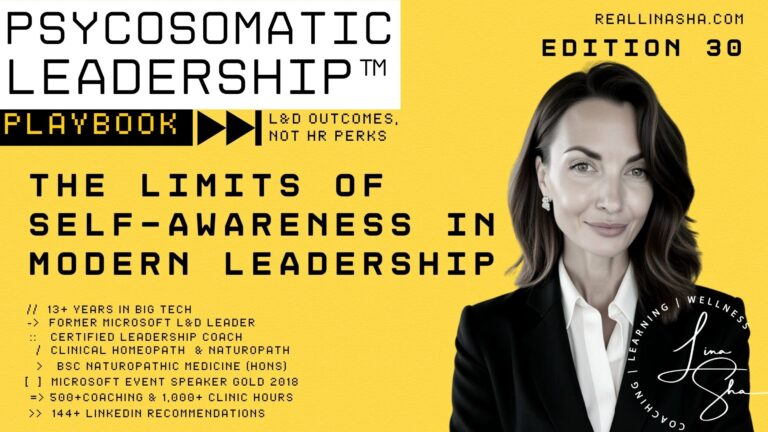
The Limits of Self-Awareness in Modern Leadership

MIND–BODY PATTERN OF THE WEEK
Self-awareness has become one of the most valued qualities in leadership. Leaders are expected to understand their strengths, recognise their triggers, reflect on their behaviour, and demonstrate emotional intelligence in how they relate to others. In many organisations, particularly in technology, self-awareness is seen as a marker of maturity and readiness for senior roles.
Hovewer, leaders who are highly self-aware still struggle to lead effectively under pressure.
They can describe their patterns with precision. They know when they are becoming reactive. They can articulate how they would ideally respond but in the moment that matters (during a product failure, a missed revenue target, or a high-stakes decision) behaviour does not follow awareness. Afterwards, the leader reflects accurately on what happened but the pattern repeats.
This is the mind–body pattern of the week: intellectual self-awareness without physiological regulation.
Psychosomatic Leadership™ defines this as a structural (and physiological) limitation.
Self-awareness operates at the level of cognition. It allows leaders to observe, interpret, and understand their internal experience but understanding alone does not regulate the nervous system. When pressure exceeds capacity, the body defaults to survival patterns regardless of what the leader knows intellectually. In these moments, awareness is present but inaccessible.
A leader may recognise that they are becoming impatient, yet still interrupt their team. They may know that a situation requires curiosity, yet feel a surge of urgency that drives them toward control. They may be aware that their reaction is disproportionate, yet be unable to modulate it in real time.
Leaders assume they need more discipline, more resilience, or more practice applying what they already know. Organisations respond by reinforcing self-awareness through feedback, reflection exercises, and leadership training.
The issue is not a lack of awareness but a lack of regulatory capacity.
In high-pressure environments such as sales and engineering, this limitation becomes more pronounced. The speed of decisions, the weight of accountability, and the constant flow of signals place sustained demand on the nervous system. Under these conditions, behaviour is increasingly driven by physiological state rather than conscious intent. This is why self-aware leaders can still create unintended impact.
Teams experience urgency, tension, or emotional distance that the leader does not intend to project. Psychological safety weakens subtly. Decision quality fluctuates. Over time, the leader may experience fatigue, sleep disruption, or other somatic signals of sustained activation.
Self-awareness explains the pattern but it does not resolve it. This is where the next evolution of leadership begins.
Psychosomatic Leadership™ recognises that awareness must be paired with the ability to regulate and integrate internal experience. It shifts the focus from understanding behaviour to developing the capacity to remain present and responsive under pressure.
As organisational complexity continues to increase this distinction becomes critical and the limits of self-awareness become visible.
L&D-LED WORKPLACE WELLBEING
If self-awareness is no longer sufficient, the question for organisations becomes practical. What is missing between knowing and doing?
It becomes clear in practice is that the gap between awareness and behaviour is not a failure of leadership intent. It is a failure of connection.
The missing link is the ability to connect cognitive insight with physiological state in real time.
Without that connection, awareness remains observational. It explains behaviour after the fact but does not influence it while it is happening. Under pressure, the nervous system continues to drive response patterns independently of what the leader knows intellectually. At the same time, the body begins to carry what the mind has already identified but not resolved.
A leader who recognises their tendency to overcommit may continue to push until the signal appears as sleep disruption or fatigue. Another who understands their reactivity may still experience it physiologically as tension, irritability, or emotional withdrawal. In these moments, the body is not introducing new information. It is expressing what has not yet been integrated.
This is where leadership development reaches its current limit. Self-awareness has been successfully built. The challenge now is integration and the capacity to act from that awareness under real conditions.
This is the shift from competency to capacity. Capacity, in this context, is not additional knowledge or skill. It is the ability to remain regulated enough for insight to be usable. It determines whether a leader can pause when needed, hold complexity without narrowing, and respond rather than react.
Psychosomatic Intelligence, measured through PIQ (Psychosomatic Intelligence Quotient), provides a way to make this capacity visible and developable. It focuses on how effectively leaders can connect what they understand with how their system is operating, moment by moment.
This is where workplace wellbeing moves from support to structure. It is no longer about helping leaders recover from pressure, but about enabling them to carry it without fragmentation. Culture becomes more stable because it is not dependent on individual resilience. Performance becomes more sustainable because it is not driven by continuous override.
As organisations continue to operate in increasingly complex environments, the question is whether leaders can act from that awareness while it is happening. That is the capability that sits beyond self-awareness and the one leadership development must now begin to build.
NERVOUS SYSTEM LITERACY IN ACTION
Leader (SVP Sales): “I understand my patterns very well. I know when I’m pushing too hard, when I’m becoming reactive, when I need to step back. I can see it clearly.”
Lina (coach): “And what happens in those moments?”
Leader: “I note it. I tell myself to adjust. Sometimes I do. Sometimes I don’t. It depends on what’s happening.”
Lina: “What do you notice in your body right now as you talk about this?”
Leader: (pauses) “Honestly, I haven’t really paid attention. I focus more on the thinking side.”
Lina: “Let’s slow it down for a moment. What’s happening physically?”
Leader: “…My heart is beating faster than it should be. And my lower back is tight. It’s been like that all week.”
Lina: “When did that start?”
Leader: “End of last quarter. Long days, a lot of pressure. It comes and goes, but lately it’s more constant.”
Lina: “What about your sleep?”
Leader: “Not great. I wake up a few times a night. Sometimes I’m just wide awake at 3 a.m. running through scenarios. But mentally I’m fine. I understand what’s going on.”
Lina: “So cognitively, you have clarity.”
Leader: “Yes. That’s the frustrating part. I know exactly what I should be doing differently.”
Lina: “And physically?”
Leader: (long pause) “I feel… broken is probably the right word. Not injured. Just fragmented. Like the system isn’t recovering.”
Lina: “What do you do when you notice the palpitations or the back pain?”
Leader: “I ignore it. There’s always something more important to deal with.”
Lina: “And when you ignore it?”
Leader: “It gets worse. The pain lingers. The sleep gets lighter. And I get more reactive, even though I know I shouldn’t.”
Lina: “So your awareness is accurate, but it’s not connected to your physiology.”
Leader: “…Yes. I’ve been treating awareness as enough.”
Lina: “What if the body is carrying the part of the pattern that the mind cannot resolve on its own?”
Leader: “Then I’ve been solving half the problem.”
Lina: “And what might change if you included your physical state as part of your leadership data, not something separate from it?”
Leader: (exhales slowly) “I’d catch it earlier. I wouldn’t need it to escalate to this level before I pay attention.”
Lina: “That’s the point where awareness becomes usable.”
Leader: “I’ve been analysing my behaviour. I haven’t been listening to my body at all.”
TAKEAWAY FOR LEADERS AND L&D PROFESSIONALS
What this conversation reveals is not a lack of self-awareness, but a lack of integration.
The leader understood his patterns with precision. What was missing was the ability to connect that understanding to his physiological state, to recognise that disrupted sleep, heart palpitations, and persistent pain were not separate issues, but part of the same unresolved load.
Coaching creates the conditions for that connection to become visible. It allows leaders to move beyond analysing behaviour and begin recognising how their nervous system is carrying what the mind has already identified. This is where awareness becomes actionable.
Without this connection, leaders remain insightful but fragmented. With it, they begin to regulate in real time, before the body is forced to escalate the signal. That is the shift from self-awareness to leadership capacity.
WHAT LEADERS SAY
What truly sets Lina apart is her ability to bridge technical expertise with a deep understanding and keen interest in the area human potential. She moves seamlessly between complex business environments and personal transformation work, drawing on a rich and diverse background in coaching, wellness, and leadership.Lina inspires those around her to aim higher and reflect more deeply. She is a trusted partner and a purposeful guide, bringing heart, intelligence, and clarity to everything she takes on. – Jason B., Director Solutions and Strategic Alliances at Megaport
NOW WHAT?
You’ve noticed how your mind and body show up under pressure now what do you do with that insight?
Awareness is only the beginning. Mind-body pattern recognition happens in real conversations, real decisions, and real leadership moments.
On my upcoming business travel I would love to meet not only my exhisting business partners and friends but also expand my network, over coffee conversations with like-minded leaders. I’m also available for leadership intensives and keynote speaking opportunities at team offsites, learning days, and sales kick-offs, where wellbeing, performance, and human sustainability need to coexist.

Not in those locations? Check out upcoming Psychosomatic Leadership™ Immersion: Mexico (November 2026) and Argentina (December 2026)
learn_with_Lina -> exec coaching, corp training, public speaking
health_with_Lina -> clinical support of mind and neuro conditions such as depression, anxiety, chronic stress, burnout, sleep disorders
time_with_Lina -> retreats
[email protected]