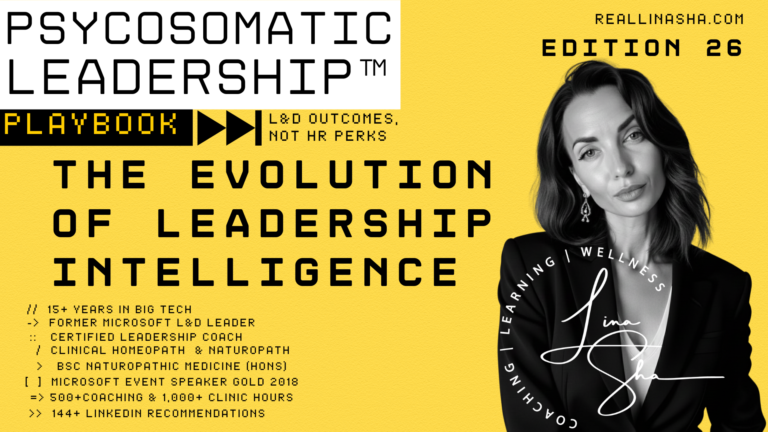
The Evolution of Leadership Intelligence

MIND–BODY PATTERN OF THE WEEK
This is the first edition of 2026, and it marks a shift in how leadership intelligence must now be understood.
Leadership has already evolved twice. First through cognitive intelligence (IQ) – the ability to analyse, strategise, and execute. Then through emotional intelligence (EQ) – the capacity to recognise emotions, manage relationships, and lead with awareness.
What is emerging now is the next evolution: Psychosomatic Intelligence.
Psychosomatic Intelligence is the ability to recognise, process, and regulate internal load at the level of the nervous system. Not just intellectually, but physiologically. It determines how much complexity, pressure, and responsibility a leader can carry without paying the cost with health, behaviour, or culture.
This evolution is not theoretical. It has become visible because leadership demands now exceed what cognitive and emotional insight alone can sustain.
Leaders today are highly self-aware. They can name emotions, reflect on patterns, and articulate values with sophistication. Yet under pressure, many still default to urgency, control, and emotional suppression. The issue is no longer a lack of insight. It is a lack of physiological integration.
EQ helped leaders understand emotions. Psychosomatic Intelligence determines whether those emotions are actually processed.
From a psychosomatic standpoint, emotions are not concepts to be managed. They are physiological events that must be completed in the body. When they are understood cognitively but not metabolised somatically, the nervous system remains activated. Stress cycles stay open. Internal pressure accumulates.
This is the defining mind–body pattern I see in senior leaders now: high intelligence operating on an overloaded nervous system.
The signals are rarely dramatic at first. Headaches that appear once the pressure lifts. Sleep that never fully restores. Digestive issues without a clear trigger. A constant background urgency, even during success. These are not signs of weakness or poor coping. They are signs that leadership intelligence has evolved faster than the body’s capacity to hold it.
As this pattern embeds, its impact extends beyond the individual. Leaders with strong IQ and EQ but low psychosomatic intelligence may still perform well, but their tolerance narrows. Listening becomes thinner. Decision-making becomes faster but less spacious. Teams feel the pace without understanding its source. Psychological safety erodes quietly, transmitted through tone, speed, and nervous system state rather than intent.
Learning is also affected. Leaders engage in development, understand the material, and demonstrate insight. But under pressure, behaviour reverts. Not because learning failed, but because the body cannot access it when regulation collapses. Intelligence without regulation becomes brittle.
Psychosomatic Intelligence changes this equation being the foundation of Psychosomatic Leadership™. It allows leaders to sense internal load before it becomes strain. To complete stress cycles rather than carry them forward. To integrate emotional experience so insight translates into behaviour under pressure. It is the difference between knowing better and leading differently when it matters most.
As 2026 begins, leadership intelligence is no longer defined by how much leaders know or even how aware they are. It is defined by how much complexity their nervous system can hold without fragmenting.
IQ built capability. EQ built awareness. Psychosomatic Intelligence builds capacity.
And capacity will decide the quality, sustainability, and credibility of leadership in the year ahead.
L&D-LED WORKPLACE WELLBEING
When leaders operate with a dysregulated nervous system, organisations pay for it repeatedly, and often invisibly.
The cost does not always appear immediately as burnout or absence. It shows up first in how pressure is transmitted. Leaders who are internally overloaded tend to mismanage pace, expectations, and emotional load, not because they lack competence or intent, but because their own systems are already operating at capacity.
A dysregulated leader tightens timelines without realising it. Urgency becomes the default tone. Decisions speed up while nuance drops away. Feedback becomes blunt or delayed. Tolerance for ambiguity narrows. Teams begin working in a constant state of alert, even when the work itself does not require it.
Over time, this has predictable consequences.
Teams burn down. Engagement erodes. High performers either over-adapt or exit. Psychological safety weakens not through overt behaviour, but through the leader’s nervous system state, the unspoken tension in meetings, the pace of communication, the inability to fully land success before moving on.
Eventually, the leader burns down too.
What often follows is extended leave, stress-related illness, neurological symptoms, or forced recovery periods that remove key decision-makers from the business at precisely the moments stability is most needed. Organisations absorb the cost through disrupted momentum, interim leadership, lost continuity, and the ripple effects on teams already under strain.
This cycle is expensive. Not only in wellbeing terms, but in human capital, decision quality, and execution risk.
Yet most organisations attempt to address it after the fact: Resilience programs are introduced. Wellness initiatives are expanded. Coaching is offered reactively. The intention is sound, but the intervention comes too late. The nervous system has already been operating beyond capacity for too long.
This is where L&D must shift from support to architecture.
When leaders lack psychosomatic intelligence, learning does not hold under pressure. Capability frameworks remain theoretical. Behavioural change collapses in moments of stress, not because leaders forgot what to do, but because their nervous systems cannot access it.
Psychosomatically Intelligent leaders operate differently. They can sense internal load before it becomes strain. They recognise when pressure is accumulating rather than compounding it unconsciously. They regulate pace, not just tasks. They allow completion, not just delivery. Their presence stabilises teams rather than transmitting urgency.
This has tangible organisational effects. Teams recover faster. Learning integrates more deeply. Decisions remain clear under pressure. Psychological safety strengthens because leaders are not leaking unresolved stress into their environment. Performance becomes intelligent rather than effort-heavy.
From an L&D perspective, this is the inflection point.
Developing Psychosomatic Intelligence means building leaders’ capacity to regulate their internal state in real time so intelligence, insight, and learning remain available when stakes are high. It moves wellbeing out of the category of perk or recovery and into the core of leadership capability.
In 2026, organisations will not be disrupted by a lack of skill or technology. They will be disrupted by leaders whose nervous systems cannot hold the complexity they are asked to lead.
L&D-led workplace wellbeing is no longer about helping leaders cope. It is about developing leaders whose nervous systems are robust enough to lead without breaking themselves or the people around them. That is the difference Psychosomatic Intelligence makes.
NERVOUS SYSTEM LITERACY IN ACTION
Leader: “I don’t think I’m stressed. I’m just carrying a lot. That’s the role. People rely on me.”
Lina (coach): “As you say ‘carrying a lot’, what do you notice happening in your body right now?”
Leader: “My shoulders lift. I didn’t realise that until you asked. They’re almost up near my ears.”
Lina: “How long do you think your body has been holding itself like that?”
Leader: (pauses) “Honestly? Years. It feels normal.”
Lina: “What does ‘normal’ cost you?”
Leader: “I’m tired, but not in a way rest fixes. I get short with my team when things slow down. And when someone struggles, I feel irritated instead of curious.”
Lina: “What do you think your nervous system is doing in those moments?”
Leader: “…Staying on guard. Like it can’t afford to relax.”
Lina: “And what happens to the people around you when your system stays on guard?”
Leader: (long silence) “They tense up too. I can see it now. Meetings feel rushed. No one really finishes a thought. Everyone’s trying to keep up.”
Lina: “If your nervous system had a leadership role in the room, what would it be modelling?”
Leader: “Urgency. Containment. Don’t stop.”
Lina: “Is that what you believe good leadership requires?”
Leader: “…I’ve told myself it does. But listening to this, it feels more like fearmongering than leadership.”
Lina: “What would change if regulation, not endurance, was treated as competence?”
Leader: “I’d slow the pace without feeling guilty. I’d stop mistaking pressure for progress. I’d give my team space to land things instead of constantly pushing forward.”
Lina: “And what do you notice in your body as you say that?”
Leader: “My shoulders dropped. I feel heavier, but in a grounded way. Like I don’t have to keep holding everything up.”
Lina: “That shift didn’t come from changing your strategy. It came from changing your internal state.”
Leader: (exhales slowly) “I’ve been managing people with a nervous system that never stands down. No wonder everyone’s exhausted.”
Lina: “What if leadership intelligence now includes knowing when your system needs to downshift, not as weakness, but as skill?”
Leader: “…Then I’ve been leading without a capacity I didn’t even know was missing.”
Takeaway for Leaders and L&D Professionals
This shift did not occur through advice, feedback, or performance optimisation. It emerged through awareness of a nervous system pattern that had gone unnamed.
The leader was not coached to do less or care more. They were supported to notice how their internal state had been shaping their leadership presence, team dynamics, and pace without conscious intent. Once the body was included in the conversation, choice returned.
This is the practical value of nervous system literacy.
For leaders, it restores access to regulation before strain turns into burnout, reactivity, or withdrawal. It allows intelligence, empathy, and learning to remain available under pressure rather than collapsing when it matters most.
For L&D, this is the missing link between development and durability. Coaching surfaces patterns that training alone cannot reach. It makes internal load visible, so leaders can integrate experience instead of carrying it forward into behaviour, culture, and health costs.
Psychosomatically Intelligent leadership is not softer leadership. It is leadership with enough internal capacity to hold complexity without passing the cost downstream. That is what nervous system literacy looks like in action.
WHAT LEADERS SAY
What truly stands out is her strong dedication to succeed – a trait shaped by her immigrant background and deep personal drive. Lina doesn’t just pursue success for herself; she uplifts those around her and leads with heart. Her career trajectory has been incredible to witness, marked not only by her achievements but by her unwavering focus on human-first leadership. – Naren G., Recruitment & Executive Search, Managing Director
NOW WHAT?
You’ve noticed how your mind and body show up under pressure now what do you do with that insight?
Awareness is only the beginning. Mind-body pattern recognition happens in real conversations, real decisions, and real leadership moments.
First half of 2026 I have quite an amazing line up of business travel and I would love to meet not only my exhisting business partners and friends but also expand my network, over coffee conversations with like-minded leaders. I’m also available for leadership intensives and keynote speaking opportunities at team offsites, learning days, and sales kick-offs, where wellbeing, performance, and human sustainability need to coexist.

Not in those locations? Check out upcoming retreats in Mexico and Argentina end of 2026 at (The Psychosomatic Leadership™ Immersion in Costa Rica 21–28 Feb is SOLD OUT)
learn_with_Lina -> exec coaching, corp training, public speaking
health_with_Lina -> clinical support of mind and neuro conditions such as depression, anxiety, chronic stress, burnout, sleep disorders
time_with_Lina -> retreats
[email protected]